CRAFT MY PLATE · PRODUCT DESIGN · 2025
Turning a sales-led catering business into an 80% self-serve product
How we translated the guidance of a sales conversation into a digital experience, moving app orders from approximately 10% to 80%.
Confidentiality Note: Sensitive and non-public information has been modified, generalized, or omitted; the work and my contribution are accurately represented.
ROLE
Product Designer
TIMELINE
Apr–Aug 2025
TEAM
Uday · Akash · Alolika · Suraj · Umang · Hardik

Context
Craft My Plate is a bulk food and catering app trusted by over 500K+ users. It handles orders for gatherings ranging from 10 to more than 2,000 guests. CMP provides three key services - Delivery Box, Meal Box, and Catering Service. Its offerings are tailored for occasions such as parties, corporate meals, events, and major milestones like weddings.

Problem - Growth was tied to scaling the sales team
Although customers can order in the app, approximately 90% of completed orders still required a sales executive to guide selection and order confirmation. As demand increased, order volume could scale only by adding more sales team capacity.
“The app had become a menu catalogue. Sales remained the actual ordering interface”
This wasn’t simply a conversion problem. It was a scalability problem.
~90%
Orders required sales involvement
60+ mins
Average time required to close an order across multiple conversations
18%
Orders affected by errors in manually entered event dets..
Customers had intent, what they lacked was confidence.
To understand why customers depended on sales, I shadowed executives, studied call recordings across services, interviewed customers, reviewed session recordings and discussed the business constraints with stakeholders.
The research showed that customers weren’t calling because they lacked purchase intent. They were calling because the product didn’t provide the guidance and reassurance required to act on it.
Choosing the right starting point
Customers didn’t understand which service suited their occasion. A large, ambiguous catalogue then expected them to build an appropriate menu from scratch.
Understanding the final value
Prices rose throughout the order, and repeated follow ups were needed for quotes. Customers found it hard to understand what was included or why the total changed.
Trusting the commitment
Paying a large amount without consultation felt risky, as traditional catering relies on recommendations and reassurance through convos
“How might we productise the repeatable guidance of sales convos, while preserving human support for orders that genuinely need it?”

Designing for clarity and trust before conversion
Customers couldn’t confidently place orders without understanding what CMP offered. So, we started from the very first interaction. The onboarding and home experience introduced CMP’s services and clarified how each varied depending on the event type and service level required. We also showcased real customer experiences early in the journey through guest counts served, testimonials, event highlights, and clear explanations of how the service operates. Trust wasn’t just a badge added at checkout; it was built gradually from the moment customers entered the product.
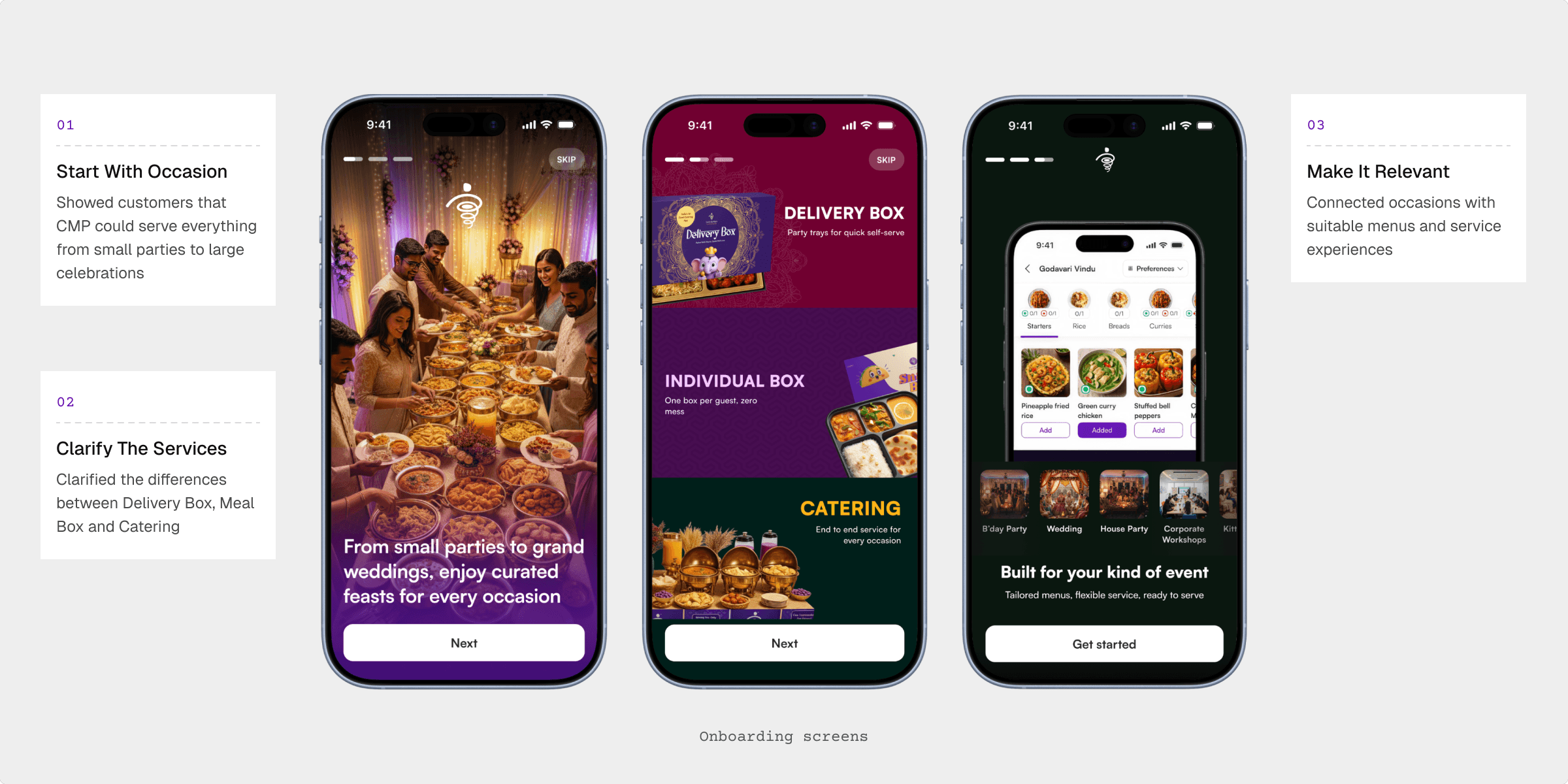

Presenting choices to Users, not complexity
Menus are tailored to users' needs, making it easy to find the best options for their occasion. Users can quickly select items for instant checkout, with a limited but relevant choice that fits their event. Details and checkout options are simplified, and transparent pricing builds greater trust from the user's perspective. The item selection screen has been iterated to ensure a smooth and clear flow through the menus.

Turn event requirements into guided recommendations
Some customers knew what they were planning but didn’t know which service, menu or budget would suit the occasion. Sales executives previously resolved this uncertainty by asking questions and recommending an appropriate starting point.
We translated that behaviour into Find My Platter. Customers shared their occasion, guest count, meal type and budget, then received a suitable service and a smaller set of curated platters. They could review the inclusions and adjust selected items before proceeding.


Reducing commitment anxiety through split payments
Even after choosing a menu, customers hesitated to pay the full amount upfront. Catering is a high-value purchase, event details can change until close to the date, and paying the entire amount through an app required more trust than the product had earned.
We brought a familiar offline catering payment behaviour into the product: customers could confirm their order with a smaller initial payment and settle the balance later. This reduced the risk of proceeding while giving CMP an earlier commitment. Approximately 50% of eligible orders used Split Payments.

Trade offs
A fully digitised journey would have simplified the funnel, reduced sales dependency and made fulfilment more consistent. But forcing complex orders and specific menu requirements into a rigid flow would have shifted that complexity onto customers. We drew the boundary in two places.
Human support remained for complex orders
Most orders for 10 to 100 guests followed predictable patterns the product could handle. Customers could still call an executive from the cart when they needed reassurance, while large catering and corporate orders sometimes serving 500–2,000+ guests with confirmation amounts exceeding ₹2 lakh, remained assisted due to negotiation, coordination requirements and reassurance
Open menu selection remained available
Curated platters made decisions faster and fulfilment more predictable. But fixed menus couldn’t accommodate every specific requirement, so we retained open menu selection rather than forcing every customer into a standardised platter.
We automated what was repeatable while preserving human judgment and customer control where they mattered
Impact
10% → 80%
Share of completed orders placed through the app over eight months


