CRAFT MY PLATE · PRODUCT DESIGN · 2026
Designing retention beyond repeat purchases
Catering is occasion led, so every completed order created an opportunity to strengthen the customer relationship beyond the event itself. I designed a post order system that turned feedback into service improvement, CSAT into referrals, and rewards into future value improving the 60-day repeat-order rate from 4.3% to 11.18%.
ROLE
Product Designer
TIMELINE
Jan 2026
TEAM
Uday · Akash
MY ROLE
I led the end to end product design from framing the retention opportunity and defining the system to designing flows, content, edge cases, and handoff. I partnered with the founder, engineering, operations, and sales to align customer value with operational and business constraints.

The Relationship Ended at Delivery
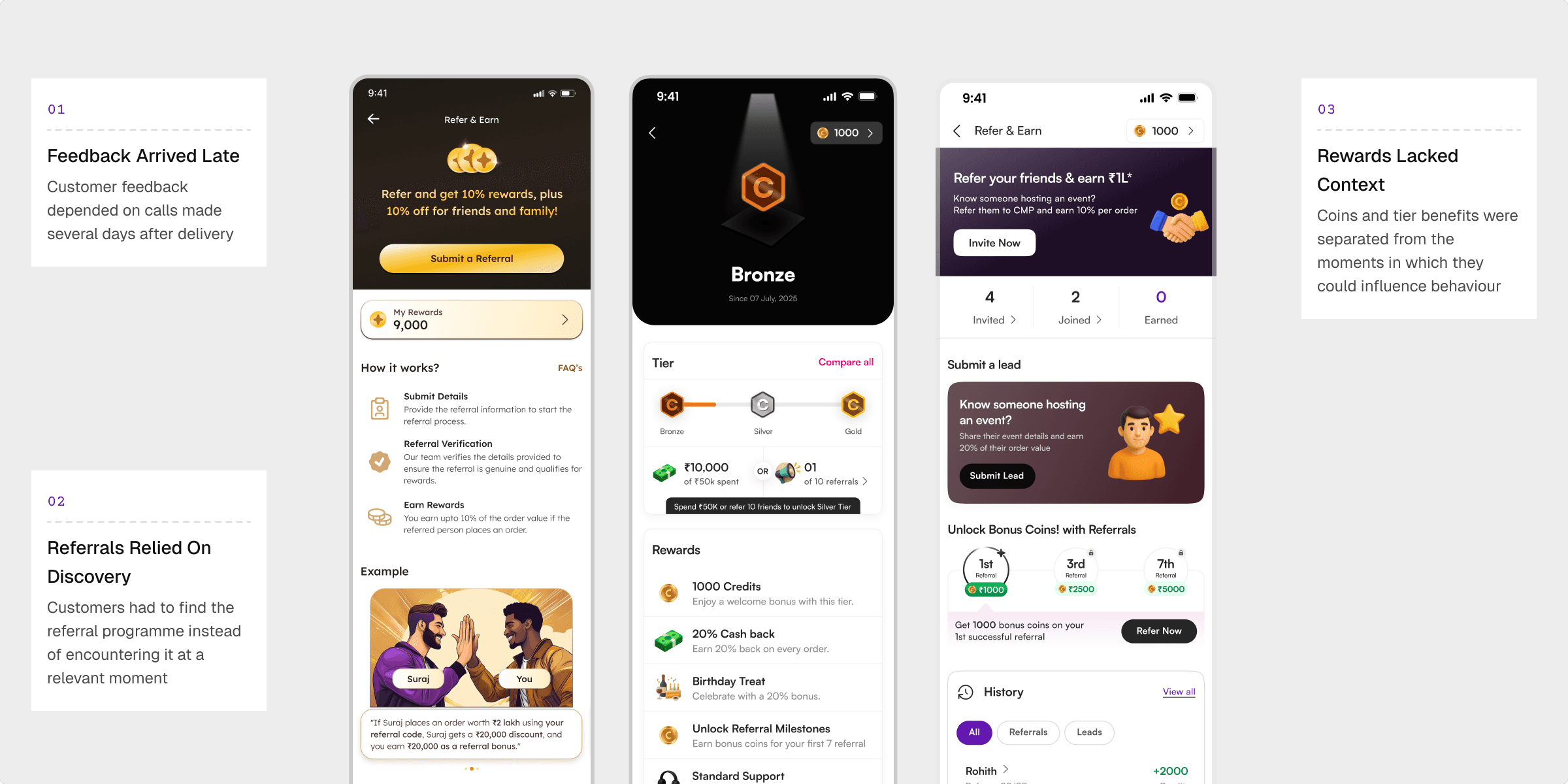
Craft My Plate was attracting customers and generating steady order volume, but the product relationship largely ended once an order was delivered. Feedback, referrals, coins and loyalty tiers already existed, but they operated independently. Feedback relied on delayed calls, referrals depended on passive discovery, and customers struggled to understand the value of their rewards.
This was not a blank slate redesign. I evaluated the existing experience using Mixpanel, PostHog session recordings, interviews across four customer cohorts, sales reports, feedback behaviour and accounts data.
Engagement was fragmented
Loyalty remained separate from ordering, referrals depended on passive discovery, and rewards were not visible during moments in which they could influence behaviour
Progress lacked clarity
Tier benefits were difficult to compare, referral tracking created friction, and customers had no obvious next action after delivery.
Retention required significant manual effort
Feedback depended on follow-up calls, customer-support escalation was disconnected from product feedback, and growth continued to rely heavily on paid acquisition.
Reframing Retention for an Occasion Led Product
Catering is driven by occasions, so retention could not depend only on another immediate purchase. A completed order needed to create one of three outcomes:
Recovery when the experience needed improvement
Advocacy when customers were satisfied
Future value when the next occasion was still months away
How might we make every completed order create the most appropriate next action?
Feedback Determined the Next Action
The previous process collected feedback through calls approximately five days after delivery. I moved it closer to the experience and structured it around specific service dimensions.

Referrals remained available inside the loyalty programme, but the primary prompt now followed a positive post-order experience. I also removed the separate Submit a Lead journey because it duplicated referrals and introduced unnecessary complexity.


Satisfaction Created a Timely Referral Opportunity
Referrals previously existed as a permanent Refer & Earn destination, which meant customers had to remember or discover it themselves.
I introduced a contextual referral prompt after a positive post-order experience, when satisfaction was recent and customers had a clear reason to recommend CMP. The permanent entry remained inside the loyalty programme for later access, while the primary referral moment became timely and behaviour-driven.
I also removed the separate Submit a Lead journey. It served the same purpose as referrals, introduced another path to understand, and generated limited value compared with the connected referral experience.


Making Progress Visible and Useful
Because customers might not order again immediately, loyalty value needed to remain understandable between occasions.
I explored reward-led, gamified and progression-led models. The progression model provided the clearest relationship between current status, the next milestone and the benefit customers could unlock.
The redesigned programme answered three questions:
Where am I now?
What benefits do I currently have?
What will I unlock next?
That progress became tangible at checkout. Tier-based redemption gave higher tiers a meaningful advantage, while the cart showed the available balance, applicable redemption and resulting savings together.


Designing for Sustainable Rewards
Tier-based rewards needed an operational system capable of monitoring their use. When a non-target segment began exploiting coin withdrawals, completely removing the benefit would have reduced customer value, while leaving it unrestricted would have created continued losses.
We introduced eligibility criteria and designed an internal control tower covering customer tiers, coin activity, referrals, withdrawals and order-level feedback. Low-rated experiences could trigger support action, while operations could monitor reward usage and potential misuse as the programme scaled.


Impact


